Saturday, 7 July 2007

A User's Diagnosis

The standard part of any support call is when the user tries to diagnose their own problems. If they can't print in A3 landscape they'll ask if I think it's a virus. If their monitor has a blue tint and has gone blurry at the corners they'll ask if it's a virus. If their mouse suddenly has all the manoeuvrability of a shopping trolley they'll ask if it's a virus.

No, I say, it's never a virus.

I don't really mind this sort of thing. I don't think they're trying to be helpful as such, I just think they're trying to come up with something to talk about with someone they don't know. It's like if I have a plumber round, I'll try to talk about what's wrong but since I know almost jack about plumbing it ends up being a bit of a one-sided conversation.

A little while ago I was talking to one user and, while she was quite charming, her attempts at diagnosis were extraordinary. Let's call her Sue.

Sue had a lot of problems on her computer: it was slow, it had things running it shouldn't have, it had software that was out of date. It was a bit of a mess. While I was working quickly, this was still taking a while and so we had a long meandering conversation. We were chatting away amiably enough when she dropped her first diagnosis:

"I think it might be haunted by my dead husband"

I laughed out loud. Thankfully so did she. I said that was the first time I'd heard that one. She then told me how her husband had died a year ago and what a lovely chap he was. He sure sounded like a swell guy.

The conversation carried on until at some point she whispered to me in a conspiratorial way. "Listen" she said.

I listened.

"Just after 9/11, I started to get these weird e-mails."

I raised an eyebrow.

"They claimed to be from someone in Al Qaeda. Well naturally I reported these to someone in IT, but they told me there was nothing they could do. They said I should just reply to them and tell them to stop. Well, I didn't think that was a good idea."

At this point I was frantically rummaging through my memory trying to think if anyone ever asked me about missives from Al Qaeda. I'm pretty sure they hadn't. I agreed that responding to terrorists was probably not a good idea.

"Well exactly," she continued, "so a few days later I said to someone in IT that if something wasn't done I would inform the Home Office. Well, shortly after that I stopped getting the e-mails, which was a relief. But then things started happening with my computer, it became slow and strange things happened."

Yep, she genuinely believed her computer was slow because it had been infiltrated by Al Qaeda in revenge for her stopping their e-mails.

Clearly she's a bit nuts, but quite charming with it. It's calls like this that make me wish I spoke to users more often.

Sunday, 1 July 2007

When Late Night Work Goes Wrong

I don't know where you work but it's very likely that your IT department has sent an e-mail to your entire company. It probably said that the e-mail server or an important application would be down in the evening. You probably looked at it, wondered why you'd care that e-mail was down at 7pm when you'd doubtless be at home eating a Marks & Spencer's curry, watching a nature documentary and just dismissed it from your mind. Quite right too.

For people like me, sending e-mails like that is a pain in the arse. Staying behind at 7pm is also a pain in the arse. But mostly I stay behind, do the work and all goes well

The problem is sometimes it all turns to shit, and when it does it usually goes something like this:
  1. A simple plan. You've planned the work you're going to do and a rough schedule. Naturally you've made it as simple as possible and told everyone exactly what they need to do and when. The plan is so simple we'll probably finish early!
  2. Like clockwork. It's all on track and everything is going better than expected. Call the wife and tell her you'll be home early!
  3. Oh shit. Something goes wrong and suddenly it dawns on you that this is not going to be simple after all. This is when you get that sick feeling in your stomach; this is going to be a late one. Even worse: What if we can't fix it? Suddenly you feel trapped in the office, and you could be there for four hours, twelve hours, maybe more.
  4. The magic hour. An hour later that problem is magically solved and it looks like you're back on track. Everyone breathes a sigh of relief, smiles, laughs and thinks about what they'll be watching on TV tonight.
  5. One more thing (AKA Oh shit, Part II). Ah yes, just one last trivial thing you need to test, so small you nearly forgot about it entirely. Oh shit, it doesn't work. Get your coats off lads, we need to get this fixed.
  6. The longest day. Now you need to work out what's wrong. Everything else functions except this one thing and that doesn't make any damn sense. You try to work through the options logically but just can't see what's gone wrong. It's late, everyone is tired and brains are starting to shut down. Nothing seems to work any more.
  7. Monkey flingers. In total frustration every stupid, dumb and destructive idea is either discussed (good) or enacted (really bad). As each idea gets shot down in flames everyone gets more frustrated. This isn't getting us anywhere and we all just want to go home!
  8. Inspiration. In all this desperate looking around someone has found something that looks wrong - it's a bit of a long shot but it might just work! Everyone get's their hopes up. It works! Now it's fixed, theories are developed as to why it went wrong.
  9. Are we there yet? There's no smiling and laughing this time, just weary relief. Someone asks if there's anything else we should test; everyone else hisses at that person to shut the fuck up. It's late, the streets are empty and the trains have stopped running now so people need to work out who's getting a cab with whom and who's going to pay.
  10. The morning after. The next day no one in the company is aware of the panic of the night before. This is the desirable however it also means nobody gets any recognition. Ah well, I'm afraid that goes with the territory.
And people wonder why I dread late night work.

Tuesday, 26 June 2007

Got the Blues

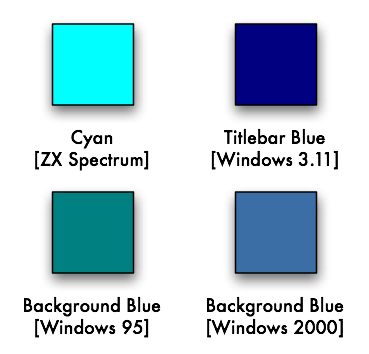
I realised today that most of my history on computers could be summarised in shades of blue.

Any game played on a ZX Spectrum that was supposed to be outdoors usually had a cyan sky. Not a pleasant colour but then there was only eight to choose from.

I guess the three other colours tell us a few things. I guess some shades of blue make nice neutral colours for a basic look. At the same time they show us how the basic colour palette has expanded as the default number of colours has gone up.

Now, of course, it would not be enough to represent OS X or XP with just a single colour; you'd need the whole background image. And those images are predominantly blue.

Saturday, 23 June 2007

Hanging Wallpaper

Recently my company was celebrating a big deal with a new business partner. Our Marketing department was arranging some activities to mark this momentous occasion and one of their ideas was to change everyone's wallpaper to an image from our partner's latest advertising campaign.

Up to now we haven't had a policy on desktop wallpaper and have left our users to stick up whatever they want: a picture of their pet lizard, a screencap from Edward Penishands, or usually just an unnaturally green hill.

Anyway, my manager comes to me and asks how we in the IT Department could make this dream a reality.

Now I'm no fool, and I can see some problems with this. Firstly, users don't like the IT department dicking about with their computers and changing stuff without a bloody good reason - it makes them anxious.

Secondly, people get very attached to their wallpaper. I remember one of our older Sales dudes had a knackered old PC with very little RAM. Large wallpaper uses up a lot of RAM so our desktop support guy removed the wallpaper to try and speed the old machine up a bit. When the Sales dude saw the wallpaper dissapear he nearly broke down in tears. It was picture of his daughter and he'd just recently got divorced: about the only chance he got to see the kid was on his damn computer.

So, I can see that we're being asked to do something that could make us very unpopular and I beg my manager to ensure that the Marketing team announce the change and that it's made entirely clear that it's their idea. My manager hates to see a grown man whimper and so agrees that he'll make that part of the deal.

Great. I then get to work on how I can do this. Unfortunately group policies are out because not all of our users are in a domain. That also rules out login scripts. Thankfully we do have a groovy product called Kaseya that enables us to deploy applications, copy files, run scripts and all sorts of other nice things. I then think I could copy a batch file in to the Startup folder in the All Users profile that'll change all the necessary registry keys everytime a user logs in. It's not a brilliant solution but it will do the job quickly and, after all, I'm on a tight deadline.

I go through my testing process and I'm shocked: my script works perfectly first time! I let the boss know that it's ready to roll and we schedule a time for the work. The boss then goes off to have a chat with Marketing.

It was at this point that everything changed. Once the Marketing department realised they'd be taking the blame they got cold feet and called it off. What was a perfectly great idea when IT were taking responsibility became a bad idea when they were. I let out a mirthless laugh.

You see, no one likes to be the bad guy and it happens too often in companies that IT are sent in to be the enforcers. We get treated like the bouncers at a night club, only there to suck the joy out of everything. Anyway, this misuse of the IT department is a subject that's a favourite of mine and I shall return to it in a later post.

I was not surprised by this turn of events. To be surprised that the Marketing department would worry about it's image is like being surprised that an orange is orange or that a fly flies. In the end it wasn't hard work and I was at least pleased that we got what I thought was the right result.

Now seems an appropriate time to quote Bill Hicks:
"By the way, if anyone here is in advertising or marketing, kill yourself. No, this is not a joke: kill yourself . . . I know what the marketing people are thinking now too: 'Oh. He's going for that anti-marketing dollar. That's a good market.' Oh man, I am not doing that, you fucking evil scumbags."


Finally, some technical stuff:


Like all good IT people I always worry about losing data. One problem with changing everyones wallpaper is that we'd lose what was there before. If a user has set their background image from Internet Explorer or Picture Viewer it's entirely possible that the desktop image is the only copy of the file they have.

One thing I know for a fact is that XP can only set BMPs as wallpaper. Even when you set a JPG as a wallpaper, it must first convert it to a BMP. The good news for early adopters is that Vista can use JPGs for wallpaper (but then let's face it, if you're using Vista you'll need all the available RAM you can get).

Well I did a bit of digging and found out where the BMP is stored. It's a BMP file in the folder C:\Documents and Settings\username\Local Settings\Application Data\Microsoft\

This could be handy to know.

Saturday, 16 June 2007

A Statement of Intent

I thought it'd be cool to write blog posts about the day to day reality of working in an IT support department but unfortunately my existing on-line presence is too easily identifiable as the real me. I'm a huge coward and I'd really hate to get sacked.

That's one of the joys of the internet: posting anonymously. For all you know I could be a lady hedgehog called Janice.

I know what you're thinking: Why Tuttle? Well, I picked the name Tuttle from a classic episode of MASH. Hawkeye Pierce invents a soldier called Captain Tuttle, and uses his wages to help a local orphanage. When Tuttle gets commended by the Army for all his good work everyone claims to have met Tuttle, leading to ha-ha-hilarious consequences. Honestly though, it really is a classic.

The name also appears in the movie Brazil where an anarchist called Tuttle gets mistaken for a civil servant called Buttle due to an bureaucratic mix-up and suffers horribly as a result.

So, Tuttle seems to be a good name to use anonymously, both as a secret identity and a victim of bureaucracy.

Anyway now I have this blog I'll use it to talk about the political challenges of working in IT and of working in an office environment in general. I'll also be unashamedly getting stuck into the technical details which might make some posts a bit boring for non-geeks but I will try my best to keep it accessible to all.

I really should be clear that I don't consider myself an uber-geek, I have no particular qualifications, and while I'm reasonably intelligent I'm hardly the greatest IT support dude to walk the earth. I'm not a manager, nor am I particularly successful in my field. I am not writing from a position of authority, I'm just trying my best to fix problems, get projects done on time and be helpful, sometimes under difficult circumstances. I just hope that my posts here are thought provoking and that they give the reader a better understanding of what happens in IT.

I will welcome discussion here and I'm happy to be corrected; I'm not always right, as much as I'd like to think that I am.

This is a pretty long mission statement but "developing synergies in emerging markets" just didn't do it for me.

I hope you'll check in regularly.